


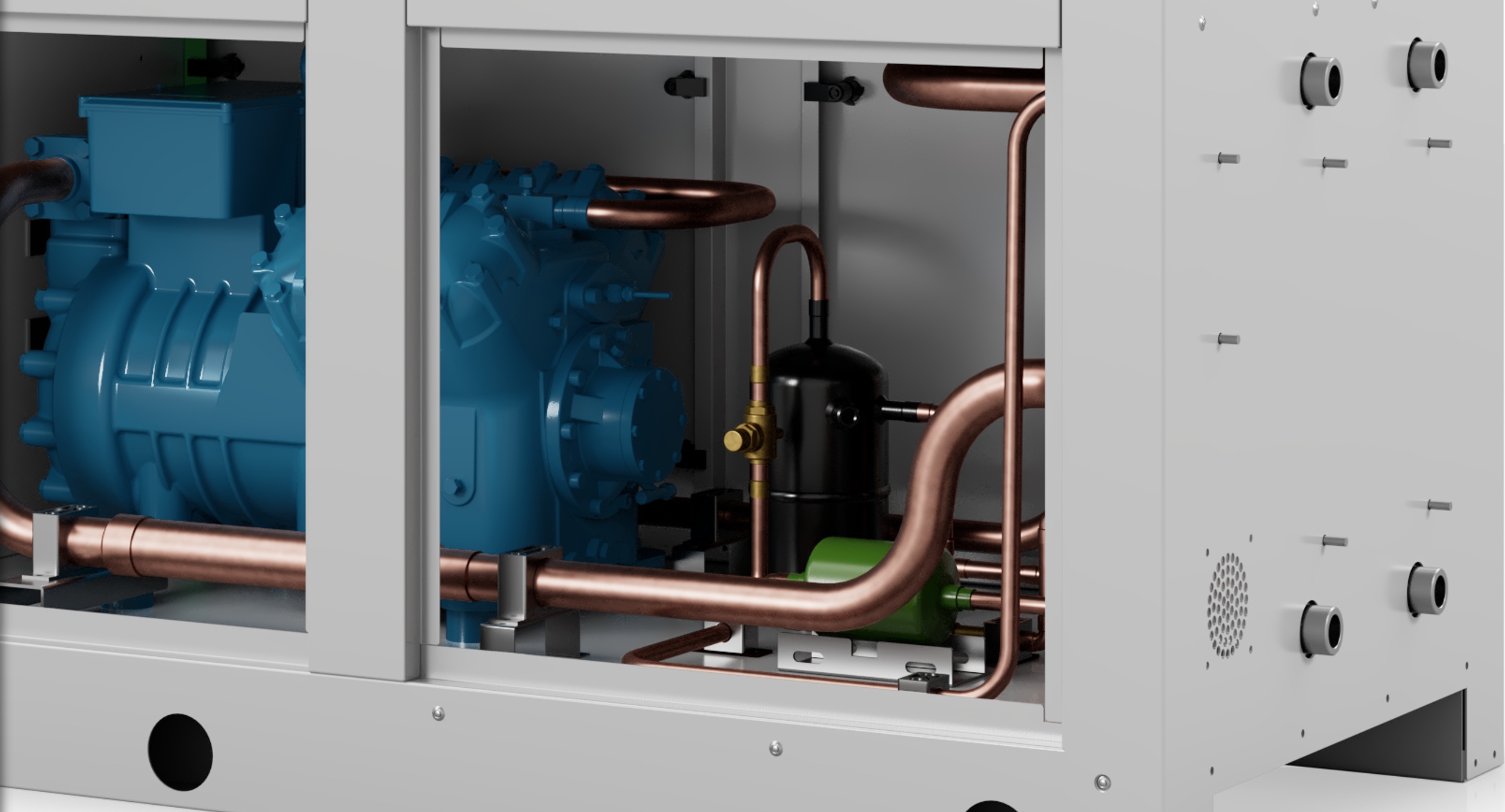
Last year we made it company policy to only supply heat pumps with Inverter compressors.
We estimate that at least 60% of the commercial heat pump products sold in the UK use on/off compressors.
We believe that it is bad advice and perhaps even unethical to sell non inverter equipment. Our stance costs us turnover but is in line with our mission to help the industry deliver the most sustainable heat pump systems possible - We put our purpose before turnover!
Efficiency
If you compare the efficiency of a non inverter piece of equipment with that of an on/off piece of equipment, it may appear that the on/off equipment is as good (and sometimes better) than that of the inverter piece of equipment. This is down to the way that efficiencies (COPs and SCOPs) are tested…….
They are tested in a lab with a constant load and so part load efficiency does not come into play. Without a fluctuating load, the conditions which occur in reality and that make on/off technology in-efficient do not occur and so the test results show an efficient operation.
In the UK, our drab but really quite mild temperatures meas that during the heating season, for most of the time the capacity requirement is only about 20% - 40% of the peak heat loss. When the ambient is higher the capacity of most heat pumps increases dramatically - usually by about 30%.
This means that in times of low required capacity (the shoulder seasons), a large turn down is required. In a 2,3,4 compressor unit scenario, the samllest compressor is often delivering more than the load and so the heat pump switches on and off alot. In certain sceanrio's an on/off multi-scroll heat pump might be able to match the load a bit better, but it will never match the load as closely as an inverter piece of equipment would and so for us it is a bad choice.............
Efficiency isn't the only reason........
Efficiency alone is enough of a reason for us to go Inverter only, but there lots of other reasons:
1.) On/offcompressor units require larger minimum water volumes to operate without problems. This results in bigger buffer vessels which take up more space, cost more and are subject to greater thermal losses, making the system less efficient.
2.) On/off compressors are less forgiving to changes in return temperature, there are many systems in the field which are suffering from refrigerant high pressure issues. Although, these issues are usually caused by poor hydraulic design, an Inverter compressor will ramp itself down and therefore avoid over-pressurising the refrigerant meaning they will not fault at times when a on/off type unit would.
3.) Heat Pumps with inverter compressors are also quieter than on/off compressor units.
Due to the climate in the UK and the fact that we design to ambient extremes i.e minus 5, our systems are usually working at part load, inverter compressors are much quieter at part load and so using an inverter driven system will mean that the sound from the machine is much lower than stated most of the time. Non inverter compressors are spinning at full speed when operational and so the noise from them doesn’t reduce.
There is also noise that an on/off compressor will make which isn’t usually shown in the noise level data – this is the loud thud you hear when one starts up. The noise levels stated are taken with the unit running and so ignore the start up thud – this is the sort of noise to wake someone up, once it has woken them up once – it will be forever a problem.
Inverter Doesn't Mean More expensive
We can supply inverter driven equipment at the same price and often much lower cost than others sell on/off technology for.
Do what makes sense, insist on an Inverter driven system!